
Vietnam Terracotta Pots for Retail Stores: Styles, Margins & Display Tips
Updated: Aug 17
Table of Contents:
Terracotta doesn't go out of style. Every season, customers walk into boutiques, home décor shops, garden retailers, and lifestyle stores looking for it—for their plants, for styling, because it feels honest and real in a way that mass-produced plastic pots never will.
For retail store owners and merchandise managers, Vietnam terracotta represents a genuinely good sourcing opportunity. The quality is real. The wholesale pricing builds strong margins. The style range is wide enough to differentiate you from Target and Home Depot. And you don't have to talk customers into wanting terracotta—they already do.
This guide is written for retail buyers. We cover the style categories that actually move, the margin math, how to display terracotta so it sells itself, and the sourcing strategy that builds a terracotta presence customers specifically seek you out for.

Why Retail Buyers Choose Vietnam Terracotta
Retail buyers look at terracotta differently than garden centers or landscape professionals. You're asking: does this fit our aesthetic? Will our customers respond? What margin can I build? Can I look different from the big-box store down the street?
Vietnam terracotta answers those questions well.
Aesthetic authenticity that customers feel. Vietnam terracotta carries visible handcraft. The slightly irregular rims. Natural color variation from firing. Tactile surface texture. Customers sense the difference from perfectly uniform mass-produced pots—even if they can't articulate why. They just know it feels better.
Margins that make retail math work. A terracotta pot wholesaling at $4–6 can retail for $18–$29. That's a 75–100% margin, significantly higher than the 40–50% you'd get on mass-produced alternatives. Better margins let you invest in store experience and inventory diversity.
Versatility across aesthetics. Rustic. Bohemian. Scandinavian. Mediterranean. Cottagecore. Contemporary minimalist. Terracotta works across all of these without forcing you to commit to one direction. This makes inventory easier to manage and your store easier to differentiate.
Year-round confidence. Customers already understand terracotta. They've been buying it their whole lives. Unlike trendy décor categories that spike and crash, terracotta is evergreen. You're not betting on a trend.
A story worth telling. Vietnam terracotta comes with something big-box retailers can't replicate: a real provenance. Centuries-old pottery traditions. Artisan craftsmanship. Sustainable clay. This narrative is a genuine competitive advantage when you know how to use it.
Terracotta Style Categories That Sell in Retail
Not all terracotta plays the same role on a retail floor. Here's how to think about the categories.
Classic Rustic: Your Foundation
The timeless terracotta form—simple, evenly proportioned, natural orange-red. No special finishing, no carved detail. Just honest terracotta.
Retail role: Foundation inventory. Every customer who walks in knows what this is. It sells reliably, year-round, across all seasons. Price: $8–$16 depending on size.
Margin: Wholesale $2.50–$4, retail $12–$16 = 75–80% margin.
How to display: Stack in size progressions. Create visual impact with quantity. Customers expect a full size range, so show it.
Who buys it: Plant parents, gardeners, bohemian enthusiasts, anyone buying their first "nice" pot.
Textured / Rustic Hand-Finished
Terracotta with visible surface texture—hand-carved patterns, applied relief, rope detail, deliberately roughened surfaces. More visual interest than plain, without losing the rustic character.
Retail role: Perceived value goes up immediately when customers can see the hand-finishing. These sit in your personality tier. Price: $14–$28 depending on size and detail complexity.
Margin: Wholesale $5–$8, retail $18–$28 = 75–80% margin.
How to display: Feature individually or in small groups where the hand-finishing is visible. These pots need to be seen clearly to be appreciated—don't bury them in a stack.
Who buys it: Interior designers, boutique shoppers, customers seeking something distinctive, gift-givers looking for something that feels special.
Geometric / Modern Minimal
Clean geometric forms—cylinders, cubes, tapered cones—in traditional terracotta material. Contemporary aesthetic, traditional material.
Retail role: For customers who love terracotta but want contemporary styling. These bridge the rustic-modern gap and appeal to apartment dwellers who wouldn't touch a classic urn. Price: $12–$24.
Margin: 75–85%.
How to display: Group by shape or height. Symmetry and alignment enhance the geometric feel. Works well on shelves with intentional spacing.
Who buys it: Minimalist home décor buyers, contemporary apartment dwellers, design-conscious customers.
Decorated / Hand-Painted
Terracotta with applied glaze, hand-painted patterns, or colored slip decoration. Art-meets-utility. These pots get purchased as much for how they look as for what they hold.
Retail role: Statement pieces and gift items. Higher perceived value. Price: $18–$45.
Margin: 70–80%—slightly lower than plain terracotta, but the absolute dollar margin per piece is substantial.
How to display: Treat like art objects. Clear sightlines. Customers need to see the decoration immediately. One or two in a display window has more impact than stacking a dozen.
Who buys it: Gift-givers, customers with eclectic or maximalist styles, people drawn to cultural or artisan products.
Large Statement Pots (50cm+): The Hero Item
Big terracotta—50cm, 60cm, 70cm and larger. Architectural pieces, focal points, conversation starters.
Retail role: The hero. One well-displayed large statement pot elevates the entire section's perceived quality. It gives your store boutique credibility. Price: $40–$120 depending on size.
Margin: The percentage is often 75–80%, but the absolute profit per piece is $40–$80. One sale of a large pot generates the same profit as selling 5–8 small ones.
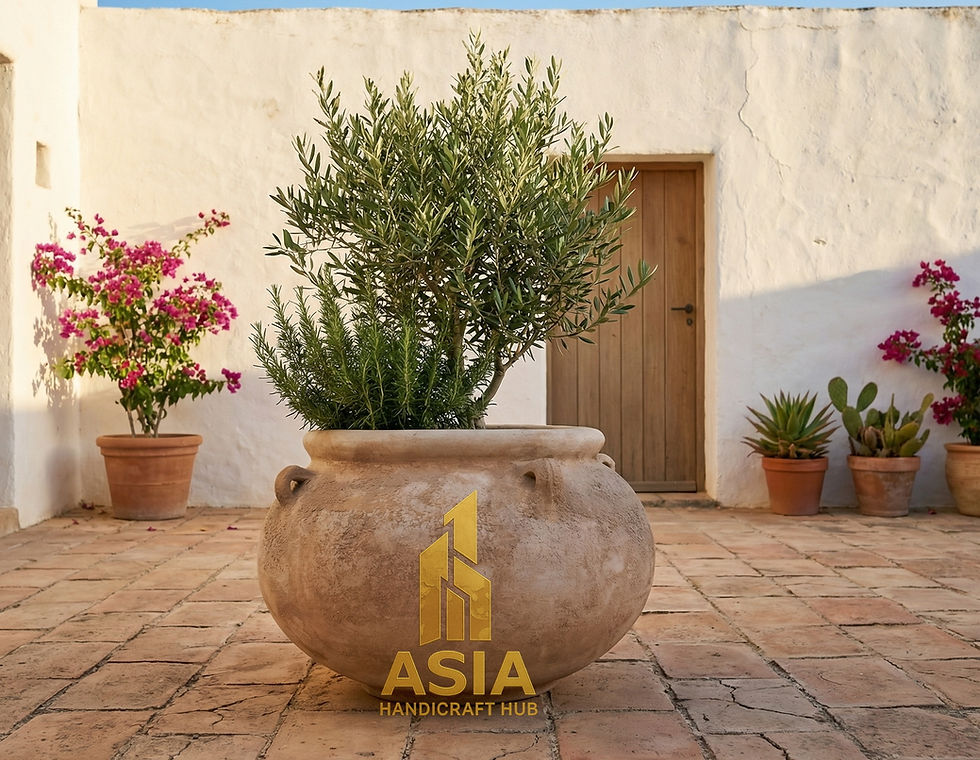
How to display: Feature prominently, one dominant piece in a focal location. Style with plants, decorative objects, accent lighting. Make it the visual anchor of your pottery section.
Who buys it: Interior designers sourcing for clients, customers planning major home projects, gift-givers with serious budgets, customers who want an investment-quality piece.
Specialty / Seasonal
Hand-painted holiday motifs, seasonal colors, limited production runs. Creates urgency, drives return visits, differentiates you.
Retail role: Competing retailers can't offer the same pieces because they source generic mass-produced imports. Limited editions give you a genuine "while supplies last" story. Price: $12–$35.
Margin: 75–85%.
How to display: Rotate seasonally. Make new arrivals visible prominently. Create intentional urgency.
Who buys it: Gift-givers, customers hunting for unique pieces, regulars who expect to see something new when they come back.
Sourcing Strategy: Building Your Retail Terracotta Assortment
covers customer needs and supports margin.
The Three-Layer Framework
Foundation Layer (60% of inventory): Classic rustic terracotta across all size ranges (10cm to 35cm). High-turnover, reliable sellers. Order ready-stock or made-to-order without worrying about being stuck with inventory.
Personality Layer (25% of inventory): Textured, geometric, or hand-painted styles. These differentiate you from competitors and support your store aesthetic. Smaller quantities per design (100–300 pieces rather than 500+). Higher perceived value.
Statement Layer (10–15% of inventory): Large pots, specialty seasonal items, limited editions. Lower volume but higher absolute margin and a serious impact on how customers perceive your store overall.
This allocation maximizes margin, turnover, and differentiation simultaneously.
Wholesale Sourcing Options
Ready-stock for core inventory: Use a ready-stock supplier for your foundation classic terracotta. Benefits: no lead time, flexible order quantities (200, 500, 1,000—you decide), quick replenishment during selling season, lower risk.
Typical pattern: January for spring, July for fall. Reorder as needed based on sell-through.
Made-to-order for specialty items: For textured, hand-painted, or limited-edition pieces, use a made-to-order producer. You get exclusive designs unavailable elsewhere, small MOQ possible (100–200 pieces), customization options, and production timing that matches seasonal arrival.
Hybrid model (what most experienced retail buyers do): Ready-stock for your foundational 60%—reliable, no lead time. Made-to-order for specialty 25–30%—exclusive, limited edition. Statement pieces sourced individually as needed. This gives you reliability, differentiation, and flexibility at the same time.
Margin Math for Retail Terracotta
Understanding your actual numbers helps you price confidently and order strategically.
Classic Rustic Terracotta (Foundation Layer)
Wholesale cost (ready-stock): $2.50–$3.50 Freight allocation: $0.30 Handling, damage allowance, shrink: $0.20 Total landed cost: $3–$4 per pot
Retail price: $12.99 (12–14cm standard size)
Gross margin: $9–$10 per pot (75–80%)
You order 500 pots. You sell 425 at full price. 75 carry over or clear at 30% off. Net margin: approximately 70%.
Revenue on 500-unit order: $5,525 revenue, $3,675 gross profit (67% net margin)
Textured Hand-Finished Terracotta (Personality Layer)
Wholesale cost: $5–$7 Freight: $0.40 Handling: $0.30 Total landed cost: $5.70–$7.70
Retail price: $24.99
Gross margin: $17–$19 per pot (71–76%)
You order 200 pots. You sell 160 at full price. 40 carry over or clear at discount. Net margin: 65%.
Revenue on 200-unit order: $3,998 revenue, $2,720 gross profit (68% net margin)
Large Statement Pot (Statement Layer)
Wholesale cost: $35–$50 Freight: $2–$3 Handling: $0.50 Total landed cost: $37.50–$53.50
Retail price: $99.99
Gross margin: $46–$62 per pot (lower percentage, but strong absolute dollars)
You order 10 statement pots. You sell 8 at full price. 2 carry over—terracotta doesn't deteriorate, so no spoilage risk. Net margin: 55–60%.
Revenue on 10-unit order: $799 revenue, $440 gross profit (55% net margin)
One sale of a large statement pot generates the same gross profit as selling 5–8 small classic pots. They earn their floor space.

How to Actually Display Terracotta So It Sells
The difference between terracotta that moves and terracotta that sits is almost always display. Here's what actually works.
Size Progressions and Stacking
Create visual impact by grouping pots in size progressions. A pyramid of classic rustic pots—small to medium to large—draws the eye and creates a sense of abundance.
Why it works: Customers unconsciously scan for size range. Seeing multiple sizes clustered together signals "they have what I need."
How to do it: Arrange on a table or shelf with largest pots at back, smallest in front. Leave some breathing room between groupings so individual pots don't disappear.
Color Story Grouping
Within terracotta's range (it's more varied than most people think), group by undertone: warm-toned, red-toned, brown-toned. This subtle sorting makes your display feel considered and helps customers find their preferred shade.
Style with Props
Display pots with complementary items: live plants or seasonal flowers inside pots, decorative pebbles or moss, wooden benches or stands, pairing of large pots with smaller pots and botanical accessories.
Styled displays tell a story and help customers imagine the pots in their own homes. Unstyled pots are utilitarian. Styled pots are lifestyle—and lifestyle sells.
Elevation and Tiering
Avoid flat, single-level displays. Use shelves, stands, or tables at different heights. Tiering creates visual interest and lets you show more product in compact space.
Window placement: One large statement pot with dramatic styling—a 60cm pot, a statement plant, accent lighting—beats a jumbled arrangement of small pots every time. Simplicity wins windows.
Seasonal Rotation
Change your display every 4–8 weeks. Seasonal colors, new arrivals, limited editions. This gives regular customers a reason to come back, and it signals that your inventory is alive, not stale.
Create anticipation: "We just received new hand-painted terracotta in Mediterranean colors." Regulars will make a trip specifically to see them.
Signage That Does Work
Create small product cards with:
Origin: "Handcrafted in Vietnam"
Production: "Hand-thrown clay, wood-fired kiln"
Care: "Suitable for indoor and outdoor use"
Story: "750+ years of pottery tradition"
Customers want to know where things come from. This signage justifies premium pricing and builds emotional connection that online retailers simply can't replicate.
Pricing Strategy for Different Store Aesthetics
Your store's overall positioning affects how you price and tell the terracotta story.
Boutique/artisan positioning: Position terracotta as handcrafted, premium, artisan. Margins 80–100%. Price a classic rustic pot at $18–$24 (versus garden center retail of $12). Boutique customers expect premium pricing and respect it. Emphasize: handmade, sustainable, artisan heritage, unique character.
Value/lifestyle positioning: Accessible quality. Margins 70–75%. Price competitively with online but emphasize in-store experience, curation, variety. Emphasize: good value, beautiful quality, diverse styles.
Gift/seasonal positioning: Rotate seasonal assortments. Gift bundles and sets. Margins 75–80%. Price small terracotta pots at $14–$18 as gift items, bundled with accessories. Emphasize: perfect gift, unique, sustainable, celebration of craft.
Interior design/project sourcing: Position as a designer resource for residential and commercial projects. Custom orders welcome. Margins can exceed 100% on custom work. Work directly with designers. Emphasize: design consultation, customization, volume flexibility.

Seasonal Strategy for Retail Terracotta
Terracotta sells year-round, but volume and positioning shift. Here's how to think about each season:
Spring (March–May): Peak planting season. Classic rustic drives volume. Customers are actively buying pots for spring plants. Emphasize size range and plant readiness.
Summer (June–August): Steady but softer than spring. Shift toward décor positioning and outdoor styling. Feature large statement pots and decorated styles.
Fall (September–November): Secondary peak. Fall planting season, holiday gifting approaching. Introduce seasonal colors and limited editions. Gift positioning becomes relevant.
Winter (December–February): Holiday gifting and New Year home refresh. Hand-painted, decorated, and specialty styles perform. Smaller pots for gift bundles.
Don't stock and display the same way all year. Adjust the assortment, rotate the display, tell a different story each season.
Building Customer Loyalty with Terracotta
Terracotta buyers often become repeat customers. They buy one pot, they plant it, they fill their space—and they come back for more. This category has natural customer loyalty built in, if you handle it right.
Develop a terracotta collector base: Communicate with repeat customers about new styles. "We just received a new collection of hand-painted Mediterranean terracotta." These customers will return specifically to see new pieces.
Show the range over time: Customers who bought classic rustic last year might be ready for textured or hand-painted this year. Show them what's possible.
Create terracotta events: "Terracotta styling workshop." "Plant potting party." "New collection reveal." These deepen customer engagement and drive traffic without discounting.
Use loyalty programs: Small discounts or points on terracotta purchases. Encourage repeat buying.
Done well, terracotta becomes a signature category—something customers come to you specifically for. That's a real competitive moat.
Ready to Build a Distinctive Retail Terracotta Presence?
Vietnam terracotta gives retail stores a real opportunity: high-margin, distinctive inventory that differentiates you from mass-market competitors while delivering genuine value to customers who care about what they bring into their homes.
Start with a foundational assortment of classic rustic pots. Build from there with specialty styles that align with your store aesthetic. Display thoughtfully. Tell the story. Watch what sells. Adjust seasonally.
Asia Handicraft Hub supplies retail stores with ready-stock Vietnam terracotta across all styles. We specialize in supporting boutiques and lifestyle retailers with curated collections, flexible ordering, and wholesale pricing that builds strong margins.
Get started:
Learn more about Vietnam pots for retail:
Frequently Asked Questions
What is a realistic markup on Vietnam terracotta pots for retail?
Typical retail markup: 75–100% on wholesale cost. A pot wholesaling at $3 should retail for $9–$12. This supports healthy margins while remaining competitive.
Can I order small quantities of terracotta from Vietnam suppliers?
Yes. Ready-stock suppliers can provide quantities as low as 50–100 pieces per design. Made-to-order MOQ is typically 100–300 pieces. Perfect for retail stores that do not need garden-center-scale volume.
How should I display terracotta to maximize sales?
Use elevation and tiering. Create size progressions. Style with plants and accessories. Rotate seasonally. Feature large statement pots prominently. Tell the story through signage.
What sizes move best in retail?
Most movement: 12cm, 15cm, 20cm, 25cm for classic sizes. Decorative and specialty styles: 20–30cm. Statement pots: 50–70cm. Carry a range; do not over-stock any single size.
When should I reorder for seasonal peaks?
For spring: order by late January for February–March delivery. For fall/gift season: order by July for August–September delivery. For year-round: maintain 4–6 week inventory of core items, with flexibility to reorder quickly.
Should I stock both rustic and decorated terracotta?
Yes. Classic rustic drives volume; decorated drives higher margins and perceived value. A 70/30 split (rustic/decorated) is typical for successful retail mix.
How do I explain the price difference between Vietnam terracotta and mass-produced imports?
Highlight: handcraft, artisan origin, sustainable materials, supporting traditional pottery villages, durability (quality lasts), unique character (no two identical). Customers understand and respect the difference.
Can I order custom decorated or hand-painted terracotta?
Yes. Minimum order typically 50–100 pieces for custom decoration. Lead time: 4–5 months. Budget 10–20% premium for custom work. Exclusive designs differentiate your store.
What is the damage/breakage rate for imported terracotta?
Typical damage in transit: 2–3%. This should be factored into landed cost. Work with suppliers providing cargo insurance and quick replacement protocols.
How can I differentiate my terracotta from online retailers?
In-store experience: styling, display, curation expertise. Staff knowledge: story, origin, care. Variety: unique styles not available elsewhere. Community: events, workshops, loyalty. Personal service: sizing help, styling advice, custom ordering.
Asia Handicraft Hub partners with boutique retailers, garden stores, and lifestyle shops to source distinctive Vietnam terracotta pots at wholesale prices that support healthy margins. We offer ready-stock flexibility, exclusive collections, and retail expertise. Contact our retail team to discuss your terracotta sourcing strategy.


Comments