
Balcony Planters: Tall Solutions for Small Outdoor Spaces
Updated: Aug 17
Table of Contents:
1. Why Tall Planters Solve Problems That Wide Pots Can't
There's a specific problem that every small balcony eventually presents: you've used the floor space you have, you still want more greenery, and you don't know where to put it.
Wide pots are great — but they compete for floor area. On a balcony measuring 4m² or 6m², every square metre taken by a large round planter is a square metre not available for a chair, a table, or a second pot. At some point, horizontal expansion runs out of room.
Tall planters work in a different dimension entirely. They go up. A 90cm column planter, a 120cm tapered floor-standing urn, a 100cm ceramic tower pot — these containers claim vertical space that is otherwise entirely unused on a balcony. They give you volume for plant roots, visual height, and a sense of scale without consuming the floor footprint of an equivalent wide planter.
Beyond the practical space equation, height does something to a small outdoor space that width doesn't. It draws the eye upward, which makes the space feel larger. It creates layering — the tall planter at one end, the mid-height shrub in the centre, the low groundcover near the door — that gives a balcony genuine depth. Interior designers talk about vertical rhythm in room design. The same principle applies outdoors, and tall planters are the most direct way to introduce it.
There's also a less obvious benefit: privacy. A 100cm planter at the balcony edge, planted with a tall grass or bamboo or a dense evergreen, creates a screen between you and the balcony next door — or between you and the street below — that a wide, low planter simply cannot.
The case for tall planters on a small balcony isn't just aesthetic. It's spatial problem-solving.
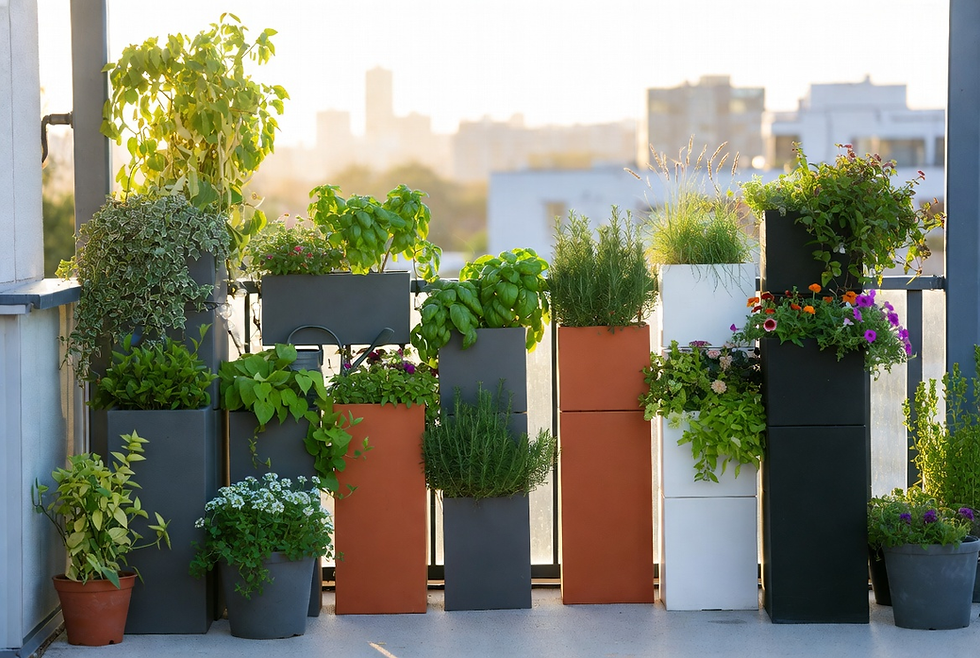
2. Tall Planter Shapes: Column, Tapered, Urn, and Trough — What's the Difference?
"Tall planter" covers a wider range of shapes than most buyers realise. The shape matters for both practical and aesthetic reasons — root depth, surface stability, and how the pot reads in a space all vary significantly.
Column Planters
Straight-sided, cylindrical containers — equal in diameter from top to base, or close to it. Column planters have the cleanest silhouette and suit contemporary, minimal balcony designs particularly well. Their straight walls mean the full pot height contributes to root depth, which benefits deeper-rooting plants.
The practical limitation is weight distribution. A tall column planter is heavy at the top relative to its base. In windy conditions — which are common on exposed balconies above ground level — a tall, narrow column pot needs anchoring or stabilising.
Tapered / Cone Planters
Wider at the top than the base — the most traditional planter form in European pottery tradition. The taper gives the pot visual stability even at height. It also makes repotting easier: soil and roots release more cleanly from a tapered interior than a straight-sided one.
The narrower base means less root depth at the bottom of the pot, which shapes what you can grow (more suitable for annuals, grasses, and plants with fibrous rather than taproot root systems).
Urn and Amphora Shapes
The classic Mediterranean statement pot. An urn has a wider body, a narrowed neck, and a defined mouth — the shape that most people picture when they imagine a large garden pot. Urns are among the oldest container forms in human history. They also remain genuinely hard to replicate in any other material as convincingly as in ceramic.
For balconies, a large urn at 80–100cm height makes a visual statement that almost nothing else in the planter market matches. It also provides excellent root volume in the body of the pot despite the narrower neck.
Tall Trough Planters
Rectangular, elongated containers — tall enough to stand at floor level and provide genuine growing depth, but shaped to run along a wall, railing, or balcony edge rather than standing as a centrepiece. Tall troughs are the best option for creating a green border along one side of a balcony: a row of bamboo or tall grasses in a trough planter along the railing creates both greenery and a visual boundary.
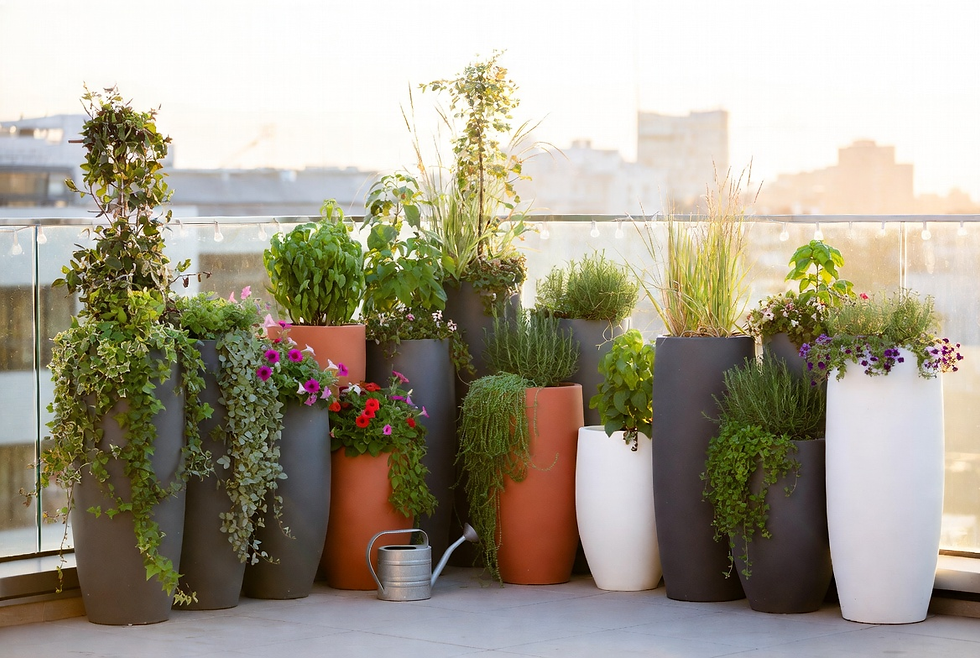
3. Material Guide: Choosing the Right Tall Planter for Outdoor Use
The material question matters more for tall planters than for low, wide ones. Height amplifies certain vulnerabilities — wind exposure, top-heaviness, frost damage — and the material you choose either mitigates or compounds them.
Ceramic Tall Planters
The premium choice. A tall glazed ceramic planter has a surface quality and visual weight that fibreglass and plastic genuinely cannot match, regardless of how well they're finished. The glaze depth, the tactile surface, the way a ceramic pot holds colour — it's a different product category at the sensory level.
For tall formats specifically, look for ceramic planters with a wall thickness of at least 12–15mm. Thinner walls on a tall pot are more vulnerable to cracking if the pot is knocked, and they offer less thermal mass to buffer temperature swings.
Vietnamese glazed ceramics in tall column and urn formats represent a genuinely competitive option at both retail and wholesale level — the combination of craft tradition and export production quality means you can access large, beautifully finished ceramic tall planters at prices significantly below European-made equivalents.
Terracotta Tall Planters
Traditional, tactile, and excellent for plants that want breathable pot walls. The limitation for tall formats is frost resistance: a tall terracotta pot has significantly more surface area exposed to freeze-thaw cycles than a squat wide one. In climates with hard winters, high-fired terracotta (from Vietnam, Italy, or Impruneta specifically) is strongly preferable to standard low-fired terracotta.
Terracotta tall planters look particularly well in Mediterranean garden schemes: tall rosemary or lavender, an olive trained into a standard, a column of Euphorbia — all read beautifully against the warm orange-brown of terracotta.
Fibreglass Tall Planters
The weight-solving option. A tall fibreglass planter can weigh 80–90% less than an equivalent ceramic. For balconies with strict structural load limits — or for upper floors where lifting a 30kg ceramic column pot up stairs is genuinely impractical — fibreglass in a quality matte or textured finish is a serious option.
The quality range in fibreglass is wider than in ceramic. At the better end of the market, a fibreglass planter in a volcanic or stone-effect finish is convincing at conversational distance. At the lower end, it reads as plastic. Buy fibreglass from suppliers who show you the product in use in real settings, not just in studio photography.
Zinc and Corten Steel Tall Planters
A specific aesthetic: raw, industrial, contemporary. Tall corten steel column planters weather to a rust-orange patina that reads as deliberately designed in the right context. Zinc planters have a cooler, more metallic finish. Both materials heat up significantly in direct sun, which can damage roots — use inner liners or pot-within-pot setups to protect the root zone.

4. Stability on a Balcony: The Safety Factor Nobody Talks About Enough
A tall planter in a wind will move. On a balcony above ground level, that movement has real consequences — a 100cm ceramic urn tipping over the balcony railing, or falling and cracking onto the balcony floor, is a safety incident, not just an expensive accident.
This is the section most balcony planting guides skip over. It shouldn't be skipped.
Wind load is real and calculable
Balconies from the third floor upward experience meaningfully higher wind speeds than ground level. Wind acts on a tall planter as a horizontal force pushing at roughly mid-height — the taller the pot, the greater the leverage it has to tip the base. A filled 100cm column planter presenting 30cm of diameter to the wind requires much less wind force to topple than a filled 50cm wide, 40cm tall pot of equivalent weight.
Weight is your primary stabiliser
Ceramic and terracotta planters are naturally heavy. A large ceramic urn filled with soil is difficult to topple by wind alone — the base weight keeps it anchored. Fibreglass planters, by contrast, are light even when filled. On exposed balconies above the third floor, lightweight tall planters need supplementary securing.
Practical stabilisation options:
Place against a wall: Never put a tall planter in an exposed central position on a windy balcony. Position against the structural wall, which blocks wind from one direction.
Use weighted bases or sand-fill: Some tall fibreglass or composite planters can be partially filled with sand in the lower section before adding soil, dramatically improving base weight without compromising plant growing volume.
Cable or bracket securing: For particularly exposed positions, a discrete bracket or cable attaching the planter to wall fixings is an engineering solution. Not beautiful, but reliable.
Low-spreading plants reduce wind profile: A tall planter with a compact, mound-forming plant has less wind resistance than one with a tall grass or climber billowing above the pot rim.
The balcony railing question:
Never position a tall, heavy planter where it could tip over the balcony railing if it fell. For planters near railings, consider fixed cable attachment as non-negotiable, particularly in rental or publicly accessible properties.
5. What to Plant in Tall Balcony Planters
The planting choice for a tall container is shaped by the pot's depth. Most tall planters — 70cm to 120cm — provide more depth than wide, low planters. That depth is a growing advantage for some plants and simply unused space for others.
Deep-rooting plants that thrive in tall formats
Bamboo (non-invasive clumping varieties): Arguably the best plant for a tall balcony planter where privacy is part of the goal. Clumping bamboo — Fargesia varieties specifically — reaches 2–3m in a container, doesn't run, and tolerates wind well. In a tall column or urn, a clumping bamboo creates a screen-to-pot combination that serves multiple purposes at once.
Ornamental grasses: Miscanthus, Calamagrostis, Pennisetum — tall ornamental grasses in a column planter create movement, texture, and seasonal interest. They're also drought-tolerant once established, which matters on exposed balconies where watering consistency is difficult.
Olive trees and bay standards: A single-stemmed olive or bay trained into a lollipop standard works well in a tall urn or tapered ceramic planter. The pot height elevates the stem, which emphasises the standard form. It's a classic garden aesthetic that translates well to a balcony with the right scale of pot.
Climbing roses, trained: A tall urn or column planter at the base of a wall trellis, planted with a climbing rose trained upward, creates the most impactful vertical garden element possible on a residential balcony. It's more maintenance than most other options — regular feeding, pruning, tying in — but the seasonal display is incomparable.
Plants that suit tall pots but don't need the full depth
Lavender, rosemary, and sage: These compact Mediterranean shrubs don't need 100cm of depth, but they look excellent in a tall terracotta planter where the pot itself provides the height and the plant provides the aromatic, textural crown. Use a free-draining mix and fill the lower portion with grit or broken terracotta to improve drainage without sacrificing the pot's visual proportion.
Agapanthus: One of the best container plants in existence. Fleshy roots that do well in a deep column pot, impressive strappy foliage all season, and dramatic blue flower spikes in late summer. Agapanthus are also somewhat drought-tolerant when established — useful for balcony gardeners who travel.
Fatsia japonica: An evergreen structural plant with bold, glossy leaves. Tolerates shade and wind better than most balcony plants. In a tall ceramic planter, a Fatsia creates a subtropical aesthetic that reads well in urban settings.
6. Using Tall Planters to Create Privacy on a Balcony
Privacy on a balcony is one of those things that matters enormously and that architects frequently forget to design for. The result is the very common urban apartment condition: a balcony that is technically outdoor space but feels permanently on display.
Tall planters are the most practical privacy solution available to balcony dwellers, because they combine function (growing plants) with structure (creating a visual screen) without requiring permanent structural alterations to the building.
The privacy planting formula:
For effective screening, you need height, density, and year-round coverage. That narrows the plant list considerably.
Bamboo (clumping): The fastest-establishing privacy screen in a container. Fargesia murielae and Fargesia rufa reach 2m in a large container within a season or two of planting, are evergreen, and create a dense screen. In a 90cm tall column planter, a mature Fargesia provides screening from about 1.5m off the ground upward — enough to obscure sightlines from adjacent balconies.
Phyllostachys (in isolation containers): Running bamboo species are invasive in the ground but manageable in containers. A tall planter acts as the isolation barrier. Running bamboos grow faster and taller than clumping varieties — useful where you need height quickly — but need monitoring to prevent rhizomes escaping through drainage holes.
Hornbeam or beech as standards: Slow to establish but ultimately more refined-looking than bamboo. Hornbeam holds its leaves through winter (they turn paper-brown but stay attached), providing year-round privacy. Trained as a standard in a tall urn, this combination is the most architecturally considered balcony privacy planting you can achieve.
Photinia 'Red Robin': Evergreen, fast-growing, and visually interesting with its regular flushes of red new growth. In a tall rectangular trough planter along a balcony edge, a row of Photinia creates both screening and seasonal colour.
Positioning matters as much as plant choice:
A tall planter needs to be at the right height relative to the privacy problem. If you're screened from the building opposite but overlooked from above, a tall plant in a floor-standing pot helps only partially. Think about where the sightlines actually come from before placing your planters.
7. Styling with Height: Design Rules for Small Outdoor Spaces
The design logic for a small outdoor space with tall planters is different from the logic of a large garden. On a balcony, every element is close to every other element — the relationship between pot, plant, furniture, and wall is intimate and unavoidable. Mistakes are visible.
Rule 1: One tall statement, everything else supports it
The most common balcony styling mistake is placing multiple tall elements — a tall planter here, a tall shelf there, a hanging basket on a bracket, a floor lamp — without a hierarchy. The result is visual competition: everywhere you look, something is demanding attention at height.
Choose one primary tall planter as the statement piece. Give it the best position, the most dramatic plant, the most interesting pot. Everything else — lower planters, furniture, accessories — is subordinate to it.
Rule 2: Tall and narrow reads smaller than tall and proportionate
A very thin column planter, however tall, doesn't create the grounding effect of a planter with some body to it. The pot needs to have sufficient girth relative to its height to feel planted rather than placed. A general guideline: the height of a balcony planter shouldn't exceed three times its diameter. Beyond that ratio, it starts to look precarious and loses the anchoring quality that makes tall pots valuable.
Rule 3: Match the pot to the wall behind it
A pale opal-glazed ceramic planter disappears against a white rendered wall. A terracotta urn pops against the same surface. A dark volcanic-glaze column pot reads dramatically against pale stonework or white render. Think about the relationship between pot finish and backdrop — the wall behind a balcony planter is always present in the visual composition.
Rule 4: Use the vertical continuation
A tall planter at 100cm height with a bamboo growing to 200cm above it creates a continuous vertical element from floor to 300cm. Guide this continuation. Train a climber to continue up a wall above the pot. Plant a tall grass that waves above the pot rim and catches the light. The pot establishes the base; the plant should continue the vertical ambition.
Rule 5: Pair heights deliberately
Tall planters look best in deliberate height groupings: one at 100cm, one at 60cm, a third at 35cm. The eye moves naturally between them. A balcony with every pot at the same height — however beautiful the individual pots — reads as flat and lacks the visual movement that makes a space feel alive.

8. Tall Planters for Commercial and Hospitality Spaces
The residential balcony is the most obvious use case for tall planters. But the commercial and hospitality market for tall outdoor planters is both larger and, in many ways, more interesting from a product perspective.
Restaurants with outdoor terraces. Hotel rooftop bars. Corporate office terraces. Retail premises with pavement or courtyard space. Café forecourts. All of these spaces share the same design challenge as a residential balcony: limited outdoor area that needs to feel considered, welcoming, and green — often with privacy requirements between zones.
For commercial buyers, tall planters serve three functions simultaneously: branding (the aesthetic of the pot communicates something about the establishment), greenery (the plant softens an outdoor space and makes it more comfortable to spend time in), and structure (planters define zones, create separation between tables, mark the boundary of an outdoor seating area).
The product requirements for commercial use differ from residential in specific ways:
Durability above aesthetics: Commercial planters face more physical contact than residential ones — chairs scraping against them, trolleys passing close, general public traffic. Wall thickness and glaze durability matter more.
Consistency across units: A hotel terrace needs twelve matching column planters, not twelve that are close-enough. Commercial buyers need suppliers who can guarantee colour and glaze consistency across a production batch — something that requires both quality raw materials and quality control.
Mobility for seasonal changes: Some commercial outdoor spaces need to be reconfigured seasonally. Lightweight fibreglass tall planters are much more practical for this than ceramic, even if the aesthetic of ceramic is preferred. Self-watering mechanisms built into commercial planters also reduce the labour burden of daily watering across a large outdoor terrace.
Supply at scale: A single hotel opening might need 50–100 tall planters. A chain rollout might need multiples of that. The commercial buyer's first question isn't "what does it look like?" — it's "can you supply this at the quantity I need, at this quality, to this timeline?"
For commercial buyers sourcing tall planters wholesale, direct import from Vietnamese suppliers meets all of these requirements at price points that domestic supply chains cannot match. Asia Handicraft Hub works with commercial buyers on exactly this kind of project specification — from sample selection through to container delivery.
9. Sourcing Tall Planters: Retail Tips and Wholesale Options
For individual buyers:
The challenge with tall planters at retail is that the selection thins dramatically above 70cm. Most garden centres and homeware stores stock a reliable range up to 50–60cm; above that, the options narrow and prices climb steeply. For genuinely tall statement planters — 80cm, 100cm, 120cm — specialist pottery importers and premium garden centres with a strong buying operation are usually the best options.
Before buying a large ceramic tall planter online without handling it: check the stated wall thickness (not just height and diameter), ask about the firing temperature or frost resistance rating if it's for outdoor use, and confirm what the packaging looks like. A 100cm ceramic pot shipped with inadequate packaging is a pot that arrives cracked — and a significant financial loss.
For trade buyers and retailers:
The wholesale case for tall planters is strong. Large-format, tall-format ceramic and terracotta planters are exactly the category where domestic retail margin is thinnest and direct import margin is widest. A 100cm glazed ceramic column planter that retails at £150–£200 in a garden centre can be sourced wholesale from a Vietnamese manufacturer at a fraction of that.
The key criteria for evaluating a wholesale supplier of tall planters:
Packing standards for tall formats: Tall, narrow pots are more vulnerable to transit damage than wide, squat ones. Ask specifically how tall planters are packed — individual foam wrapping, double-walled cartons, wooden crating for statement pieces. Damage rates on a shipment of 100cm ceramic columns are a direct cost.
Glaze and finish consistency: For tall planters specifically, the glaze finish needs to be consistent across the full height of the pot — not just on the rim and shoulders, which are easy to access during production, but on the lower body and base, where application is harder. Ask for photos of the base and lower third of sample pieces.
Size range depth: A supplier worth working with should offer tall formats across a range of heights — 70cm, 90cm, 100cm, 120cm — so you can build a coherent retail range rather than a single size point.
Asia Handicraft Hub supplies tall ceramic and terracotta planters in column, tapered, and urn formats across the 60–120cm height range. We work with both first-time import buyers and established wholesale customers, and we're happy to discuss sample programs before a full order commitment.
FAQs: Tall Balcony Planters and Vertical Outdoor Gardening
Q: Are tall planters safe on a balcony?
A: Yes, with proper precautions. Ceramic and terracotta tall planters filled with soil are heavy enough to remain stable in most conditions. The main safety concern is wind exposure on upper-floor balconies — position tall planters against structural walls rather than near railings, and for lightweight fibreglass planters in exposed positions, use wall brackets or cables to secure them. Never place a tall, heavy planter where it could tip over a railing if it fell.
Q: How tall should a balcony planter be?
A: It depends on what you're trying to achieve. For general planting interest and vertical rhythm, 70–90cm pots are practical and visually effective. For privacy screening with tall plants, 90–120cm pots give you the base height to allow bamboo or tall grasses to reach useful screening height. For pure statement aesthetics, a single 100cm+ urn or column pot in the right position is more impactful than several smaller ones.
Q: What is the best plant for a tall balcony planter?
A: Clumping bamboo (Fargesia species) is arguably the most versatile choice — it establishes quickly, grows tall, is evergreen, and tolerates wind and partial shade. For Mediterranean aesthetics, a standard olive or bay in a tall terracotta urn is hard to beat. For low maintenance with dramatic effect, ornamental grasses like Miscanthus or Calamagrostis suit tall column planters well.
Q: Can I use a tall ceramic planter outdoors in winter?
A: High-fired ceramic planters can be used outdoors year-round in temperate climates. The key factors are firing temperature (higher firing produces a denser, less porous clay body that resists frost damage) and drainage quality. A tall ceramic pot that retains water in the clay body through a freeze-thaw cycle is at risk of cracking. Ensure excellent drainage, empty saucers after rain in cold weather, and if in doubt about the frost resistance rating, move statement ceramic pots to a sheltered position during hard freezes.
Q: How do I stop a tall planter from blowing over?
A: Weight is the primary stabiliser — a heavy ceramic or terracotta pot filled with soil is difficult to topple by wind alone. For lighter fibreglass or composite tall planters: position against a wall, partially fill the base section with sand before adding soil, or use discrete cable fixings to a wall bracket. Choosing compact, lower-growing plants rather than tall grasses or bamboo also significantly reduces wind resistance in the planter.
Q: Do tall planters need special potting mix?
A: The potting mix requirements are the same as any large container — good structure, free drainage, appropriate moisture retention for the plant. For tall column planters with a deep root zone, a loam-based mix (like John Innes No. 3 for permanent plantings) performs better than peat-based mixes, which can compress and lose structure over time. For very deep planters (90cm+), filling the lower 20–30cm with a free-draining material (coarse grit, broken terracotta) reduces the total weight somewhat without significantly affecting root volume for most plants.
Q: What's the difference between a tall planter and a standard large pot?
A: Proportions. A tall planter has a height-to-width ratio greater than approximately 1.5:1 — it's taller relative to its width than a conventional round pot. This proportion gives it a different visual effect (upward emphasis, space efficiency) and different practical properties (more root depth, greater wind vulnerability, better suited for certain plant types). Standard large round pots prioritise volume and visual mass; tall planters prioritise vertical presence and space efficiency.
Q: Are tall terracotta pots frost-proof?
A: Not all of them. Standard low-fired terracotta is porous and can crack when moisture absorbed into the clay body freezes and expands. High-fired terracotta — Italian terracotta from Impruneta, or Vietnamese high-fired terracotta — is denser, less porous, and significantly more frost-resistant. If you're buying terracotta tall planters for outdoor year-round use in a frost-prone climate, always confirm the firing temperature and frost resistance rating with your supplier.
Q: Where can retailers source tall planters wholesale?
A: Direct import from Vietnamese wholesale suppliers is the most cost-effective route for retailers and garden centres needing tall planters at trade prices. Domestic supply chains carry significant markup on large-format planters, and the selection above 80cm is typically thin. Asia Handicraft Hub supplies tall ceramic and terracotta planters across the 60–120cm height range, with glazed, matte, and terracotta finishes, to trade buyers internationally.
Q: Can tall planters be used to divide a balcony into zones?
A: Yes, and this is one of their most effective uses. A row of three tall column planters planted with bamboo or tall grasses creates a soft dividing wall between a dining zone and a lounging zone on a larger balcony. Unlike physical screens or walls, planter-based zoning is flexible, moveable, and integrates greenery into the architectural function. It also avoids the planning and building consent questions that permanent structural alterations to a balcony can raise.
About Asia Handicraft Hub
Asia Handicraft Hub is a Vietnam-based wholesale supplier specialising in ceramic plant pots, terracotta planters, and artisan handicrafts for trade buyers, garden retailers, landscape designers, and commercial operators across the UK, Europe, Australia, and beyond.
Our tall planter range — ceramic column pots, tapered urns, floor-standing terracotta in large formats — is produced by Vietnamese craftspeople with a genuine pottery tradition behind them. The result is product that looks different from what domestic distributors carry, because it is different: hand-finished, distinctively glazed, and built to a quality standard that holds up to the scrutiny of premium retail buyers.
We supply tall ceramic and terracotta planters from 60cm to 120cm in height, across multiple glaze finishes including volcanic glaze, opal glaze, reactive glaze, and aged patina terracotta. Whether you need a statement single piece for a commercial terrace or a coordinated range of tall planters for a garden centre floor, we work with you to get the product right before you commit to a container order.
Asia Handicraft Hub
Website: www.asiahandicrafthub.com
Reach out with your requirements — product, quantity, timeline — and we'll take it from there.

Comments